For the first time in decades, supply in the field of education is outpacing demand as more international schools open their doors while expat numbers decline.
This shift demands smarter strategies, especially for American curriculum-based institutions in Southeast Asia.
This has made digital channels become more indispensable in this new reality. Parents are turning to online sources in droves when researching schools, with 73% of school advertising recall happening through digital platforms.
Additionally, positive word-of-mouth remains the most powerful marketing channel, but parents consult multiple sources before making decisions about their children’s education.
With our years of consulting at EduVision, we’ve identified three simple yet powerful marketing approaches that resonate strongly with parents of prospective students. These strategies help American curriculum schools in Southeast Asia stand out in an increasingly competitive market.
Whether you’re struggling with admissions targets or simply looking to enhance your school’s digital presence, these parent-approved marketing ideas will help you connect authentically with families while protecting your digital assets.
Let’s explore them…
1. Simplify Admissions with Personalized Video Campaigns
“Video marketing solidifies your online presence whilst building deep and meaningful relationships with your customers. It adds a personal touch to your brand whilst increasing your conversions!” — Lilach Bullock, Content Marketing and Social Media Expert
In this time period of rapid digitalization, personalized video has been recognized as a powerful tool for international schools looking to enhance their admissions process.

Its pertinent to note that the generation of students (and parents) you’re trying to reach have grown to enjoy personalized content and visual storytelling.
As a consequence, traditional text-based communications often fail to make an impact in your international school marketing efforts.
Why parents love personalized video messages
The statistics behind video’s effectiveness are compelling. When viewers watch video content, they retain an astonishing 95% of the message, compared to just 10% when reading text.
Furthermore, embedding videos in emails has been shown to boost click-through rates by 300%. These numbers aren’t just impressive—they represent real opportunities to connect with prospective families in meaningful ways.
Parents of international school students particularly appreciate personalized content. According to research, 56% of students prefer web content that’s personalized and based on their interests.
This preference extends to their parents, who are making significant decisions about their children’s education. What makes personalized videos so effective for international school marketing?
- Emotional connection – Videos create authentic, personal experiences that resonate with families making important educational decisions
- Clarity of information – Complex admissions processes become easier to understand through visual presentation
- Convenience – Parents can pause, rewind, and review information at their own pace
- Cultural sensitivity – Videos can be tailored to address specific cultural expectations of families in Southeast Asia
For American curriculum schools in Southeast Asia, personalized videos offer an opportunity to stand out in an increasingly competitive market.
As we have observed through working with international schools, these forms of content help create that crucial first impression that can determine whether a family continues in your admissions funnel.
Examples of effective school video campaigns
Several schools have already implemented successful video marketing strategies that have yielded impressive results.
In that case, you might already be wondering what types of video content resonate most with parents considering international schools?
Based on our market research and experience at EduVision, here are some video ideas that will help you stand out:
Student-centered testimonials: Forman School created a compelling campaign featuring student stories enhanced by parent testimonials. The video production usually would involve the use soothing music and soft narration.
This is not done at random.
Rather, it is a carefully curated attempt to influence viewers to learn more about the school. Focusing and emphasizing on the student’s stories helped parents visualize their own children’s potential experience.
Resilience narratives: McCallie School produced an effective video highlighting how students overcame challenges during the 2020 pandemic lockdown.
Contrary to the expected sad tales, they showed more of students expressing their appreciation for their school community in the time being. This approach successfully increased parent trust in the institution.
Campus environment showcases: Trinity-Pawling School utilized impressive drone footage combined with beautiful background music to showcase their campus environment and educational culture.
With this, international families are able to visualize the setting where their children will learn.
Modern educational systems: Springfield’s video captured various footage of students studying and having a great time with their state-of-the-art educational approach.
For American curriculum schools in Southeast Asia, demonstrating how educational innovation translates to student engagement is particularly effective.
The common thread in these successful campaigns is their adherence to the first rule of video marketing: “Show, don’t tell“.
Rather than simply listing features, these schools focused on visual storytelling, emotions, and demonstrating their unique educational culture.
So, where do you start?
At EduVision, we’ve developed comprehensive video marketing solutions specifically designed for international schools in Southeast Asia.
Our platform offers a robust, secure media portal optimized for the K-12 market, providing solutions for video capture, creation, and publishing in a cost-effective, easy, and secure manner.
2. Leverage Social Proof Through Parent Testimonials and Reviews
Parent testimonials and reviews represent a powerful yet underutilized asset in international school marketing.
As competition intensifies among American curriculum schools in Southeast Asia, genuine parent voices have become increasingly influential in the decision-making process of prospective families.
Why parent testimonials build trust
Trust is the cornerstone of any educational institution’s marketing success. Recent studies show that 91% of 18-to-34-year-olds trust online reviews, making them essential for reaching the demographic of young parents considering international schools for their children.
Moreover, with 88% of users likely to overlook a negative review if they see the business has responded appropriately, managing your testimonials becomes even more crucial.
The fundamental reason testimonials work is their authenticity. Unlike traditional marketing materials, testimonials offer unfiltered glimpses into real experiences.
At EduVision, we’ve observed that parent-to-parent communication carries significantly more weight than institutional messaging. Consider these compelling reasons why testimonials build trust:
- Emotional resonance – Parents connect with stories from families similar to their own
- Social validation – Seeing others make the same educational choice reduces perceived risk
- Authentic insight – Real experiences reveal aspects of school life that marketing materials cannot capture
- Decision confirmation – Testimonials help validate complex educational investments
The reputation of a school serves as a powerful indicator of its success. Prospective families research schools extensively before making decisions, often consulting multiple sources.
As one parent candidly shared:
“When researching the best school for my kids, I found the feedback from parents to be the most useful in helping me land on the right decision“.
Best practices for collecting and showcasing reviews
To maximize the impact of testimonials in your international school marketing strategy, following established best practices is essential.
First, encourage your school community to leave reviews on popular platforms where parents often search for information about schools, such as Google, Facebook, or education-specific review sites.
For collecting high-quality testimonials, consider these proven approaches:
- Email campaigns – Send targeted emails with direct links to your review platforms
- QR code placement – Display signs around campus with QR codes linking to review platforms
- Event announcements – Make announcements at school events about the importance of reviews
- Social media reminders – Post regular reminders on your school’s social channels
- Website guides – Create simple guides explaining the review process
Nonetheless, collection is only half the equation. The presentation of testimonials significantly impacts their effectiveness. To showcase testimonials optimally, place them where they’ll receive maximum visibility:
- Create a dedicated testimonials page on your website
- Feature scrollable testimonials on your homepage
- Add testimonial quotes to admissions emails
- Include testimonials in your viewbook
- Display testimonials on presentation screens during open houses
- Create social media posts highlighting parent testimonials
- Develop Instagram Story highlights collecting testimonial content
The format of testimonials also matters immensely.
Without stuttering, I will tell you that video testimonials create the strongest impression, although written testimonials with photographs also perform well.
Henceforth, you can do a research on Tessa International School and consider following their approach of personalizing testimonials by referring to each family as “[student’s name]’s parents” to create a feel of community.
This will make everyone feel at home and connected.
We’ve developed a comprehensive approach to online reputation management specifically tailored for American curriculum schools in Southeast Asia.
As reported in previous studies, 68% of consumers are more likely to trust reviews when they see a mix of good and bad feedback, which is why our strategy focuses on authenticity rather than pursuing unrealistic perfect ratings.
3. Host Virtual Open Houses with Real-Time Q&A
“Stop selling. Start helping.” — Zig Ziglar, Public Speaker and Author
Virtual engagement opportunities have fundamentally changed how international schools connect with prospective families.
As part of a robust international school marketing strategy, virtual open houses with real-time Q&A sessions offer unparalleled advantages for both schools and parents.
These digital events have evolved from simple necessity during global disruptions to essential components of forward-thinking recruitment approaches.

Why virtual open houses are parent-friendly
Virtual open houses create accessibility that traditional in-person events simply cannot match. First, they eliminate geographical barriers, allowing families from across the world to participate without the need for travel.
This global reach is particularly vital for American curriculum schools in Southeast Asia seeking to attract international families.
Beyond accessibility, modern parents value flexibility above all. Today’s families juggle increasingly demanding schedules, yet still want comprehensive information about potential schools.
Virtual open houses meet this need by offering both live and on-demand options, appealing to more families without adding to school workloads.
The convenience factor cannot be overstated. As one education specialist notes, “Families can now get all of the information they need about your school from their homes, while being able to put a face to the name”.
This comfort-of-home participation removes significant barriers to engagement and allows parents to:
- Attend from any location worldwide
- Participate using any device
- Save time and resources on travel
- Access recorded content after the event
- Focus entirely on school information rather than logistics
In essence, virtual open houses democratize access to educational information. This aspect is especially important for American curriculum schools in Southeast Asia, where prospective families may be spread across multiple countries and time zones.
Features that make virtual events successful
Not all virtual open houses deliver equal results. Based on extensive research and implementation data, certain features consistently drive higher engagement and conversion rates.
At EduVision, we’ve identified these critical elements that transform standard virtual events into powerful enrollment drivers.
Interactive engagement opportunities stand out as the most influential factor. Successful virtual open houses are never just a series of talking heads—they invite families to participate through questions and direct interaction with community members.
Breakout rooms in platforms like Zoom allow prospective families to meet with current students, parents, and faculty in smaller settings that foster genuine connection.
Live Q&A sessions represent the heart of effective virtual open houses. These interactive segments enable attendees to engage directly with school representatives, ask specific questions, and receive immediate answers.
This real-time exchange creates authentic community connections that static presentations cannot replicate.
Content authenticity matters tremendously. The most compelling virtual open houses showcase a school’s genuine culture and values rather than polished marketing messages.
The structure and format of virtual events significantly impact their effectiveness:
- Pre-recorded content for campus tours and welcome messages
- Live elements for Q&A and community interaction
- Interactive polling to gage attendee interests and concerns
- Multiple touchpoints beyond the main event (weekly Q&A, virtual meetings)
- Predictable scheduling to help families plan ahead
International School of Community Service (ICS) exemplifies these principles in practice. Their virtual open house features the Head of School and division principals, followed by an extensive Q&A session moderated by their Director of Teaching and Learning.
This structured yet interactive approach maximizes both information delivery and personal connection.
Our consultation firm also helps American curriculum schools in Southeast Asia develop comprehensive virtual event strategies.
This approach goes beyond basic technical support to provide end-to-end solutions uniquely designed to your specific school community and enrollment goals.
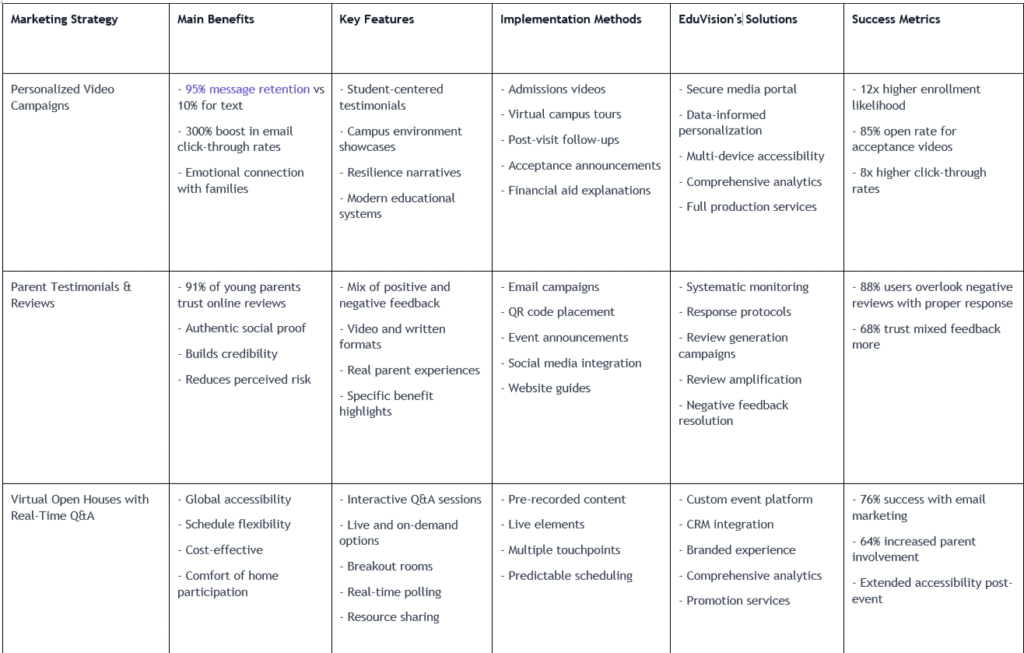
Comparison Table
Conclusion
The international school landscape in Southeast Asia has undoubtedly transformed as digital channels dominate parent research processes.
This reality leads to the need for both strategic thinking and authentic connection from American curriculum schools seeking to maintain a competitive advantage.
By following the approaches we have shared with you, your school will effectively address what parents truly value: authentic glimpses into school life, convenience that respects their busy schedules, and personalized attention that makes them feel valued.
These strategies likewise align perfectly with changing parent behaviors – particularly their preference for digital research and multiple information sources.
Contact our EduVision team today to discuss how we can transform your international school marketing approach and help you achieve your enrollment targets for 2025 and beyond.